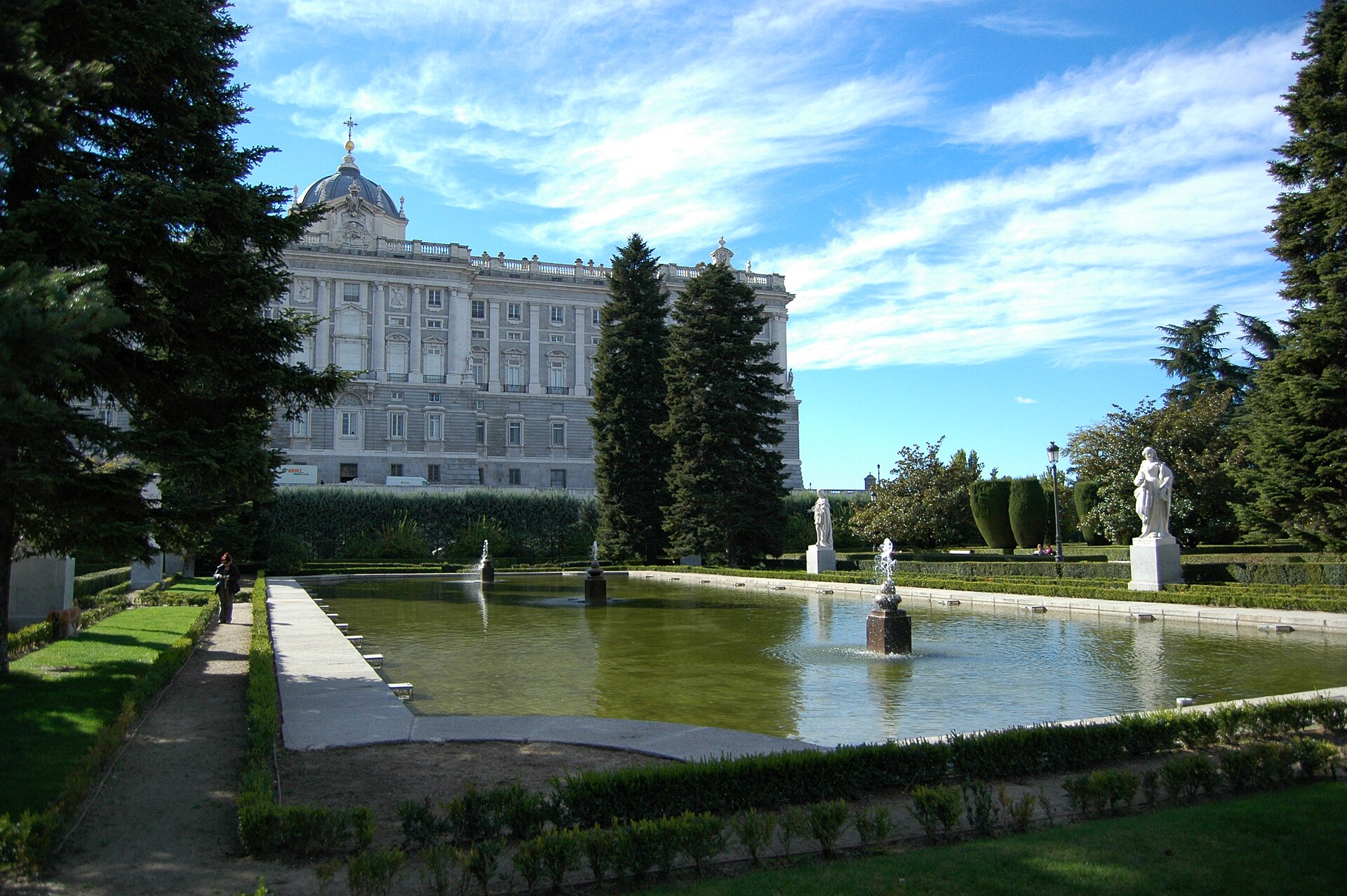
Sabatini Gardens, or Jardines de Sabatini, is a formal green space beside Madrid’s Royal Palace. Its geometric layout, clipped hedges, fountains, statues, and palace setting make it a compact sightseeing stop in the city centre. The garden occupies the site of former royal stables and takes its name from Francesco Sabatini, an eighteenth-century architect associated with the Spanish court. Sabatini Gardens, known locally as Jardines de Sabatini, is a formal garden located in Madrid, Spain. The gardens sit adjacent to the Royal Palace of Madrid, occupying a prominent position in the city center. They were constructed in the twentieth century on the site of former royal stables, taking their name from Francesco Sabatini, an eighteenth-century architect associated with the Spanish court. The space presents a neoclassical garden design with geometric layouts, ornamental hedges, and fountains. The gardens are publicly accessible and serve as a recreational area for residents and visitors seeking a structured green space near major historical monuments. The gardens are adjacent to the Royal Palace and share historical associations, but they occupy a separate space constructed later on former royal stable grounds.
Walk along the symmetrical paths to see the garden’s carefully arranged hedges, ornamental trees, fountains, and statuary. The orderly design is the main attraction: straight lines and balanced planting frames create strong views toward the Royal Palace and surrounding architecture. Benches provide places to pause, while the elevated position gives the garden a distinct perspective over the nearby palace district. The gardens feature formal landscaping characteristic of neoclassical design. Visitors encounter symmetrical pathways, manicured hedges arranged in geometric patterns, and central fountain elements. Statuary is present throughout the grounds, contributing to the classical aesthetic. The elevated position of the gardens provides views toward surrounding architecture, including aspects of the Royal Palace. Seating areas allow for rest within the landscaped environment. The plantings include trees and shrubs maintained in formal arrangements. Water features operate as focal points within the symmetrical layout. The overall composition emphasizes order, balance, and historical reference to royal garden traditions rather than naturalistic or informal planting schemes.
Allow thirty minutes to one hour for a complete walk through Sabatini Gardens. A short visit covers the principal paths, fountains, statues, and palace-facing viewpoints. Stay longer if you enjoy photographing formal landscapes, sitting among the hedges, or pairing the garden with the Royal Palace and Plaza de Oriente. Its compact scale makes it easy to add between larger Madrid attractions.
Spring and early summer bring fresh planting and long daylight, while autumn and winter give the garden a quieter, more restrained atmosphere. Morning and late afternoon are comfortable choices for walking and photography, especially when the palace-facing compositions benefit from softer light. Summer midday can feel bright across the open paths, so plan your visit around your tolerance for sun and heat.
Sabatini Gardens are a public garden beside the Royal Palace, and their garden visit is distinct from entering the palace itself. Treat the two experiences as separate stops in your Madrid plan: the palace has its own visitor arrangements, while the garden functions as an outdoor public space. This separation lets you enjoy the hedges, fountains, and views even when your main plan is focused on the surrounding district.
The gardens sit next to the Royal Palace in central Madrid, close to Plaza de Oriente and other major sights. Reach the palace district by Madrid Metro, bus, or on foot from nearby central neighbourhoods, then follow local signs and pedestrian routes toward the palace grounds. The location works particularly well as part of a walking circuit linking the palace, historic centre, and nearby plazas.
Wet weather can make garden paths slippery, and the open geometric sections offer strong sun exposure during bright summer afternoons. Keep to visitor routes around fountains, statues, elevated edges, and retaining structures. The palace district can become busy with sightseeing groups and passing traffic, so keep personal belongings close and allow extra space when stopping for photographs. The garden remains an urban setting despite its greenery.
Use the central paths, clipped hedges, fountains, and statues to build balanced, symmetrical compositions. The Royal Palace supplies a strong architectural background, while the elevated edges create downward views across the garden. Morning and evening light can emphasize shadows and geometry. Give other visitors room along the main axis, and protect camera equipment from rain when the paths are wet.
Nothing non-essential is set before you choose, in regions where consent is required. If you decline, ads still appear and analytics is switched off entirely.

_07.jpg)