
1 min walk · Innere Stadt
Graben
- Must see
- Historic monument
Language · 11 published
Historic monument · Innere Stadt, Vienna
Reviewed by Elena Voss · Roavina Travel Editor
Read from the OpenStreetMap access tags; anything not listed has no tag recorded.
Set the group type to family in the planner and the day window contracts to about three quarters of a solo day.
This place is a Attraction. It opened in 1694. It was built in the baroque architecture style. It was designed by Paul Strudel. It is built of marble. It carries the Listed objects in Austria heritage designation.
The Pestsäule is a promise made by an emperor who had left town.
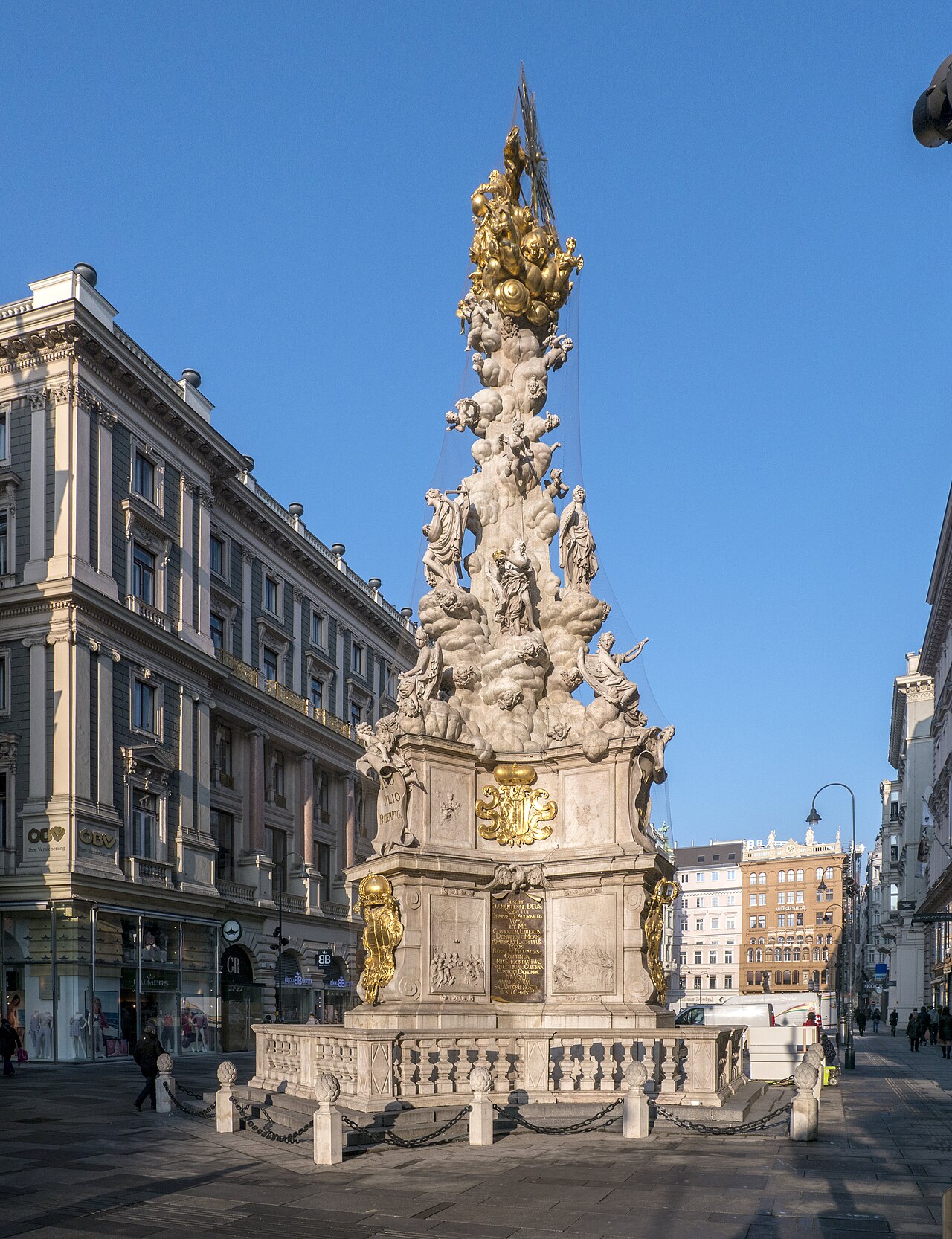
Plague struck Vienna in 1679. Leopold I fled the city and vowed to raise a column if the epidemic ended. A provisional wooden one, designed by Johann Frühwirth, was inaugurated the same year — the Holy Trinity above a Corinthian column with nine sculpted angels for the Nine Choirs.
The marble replacement took fourteen years. It was finished in 1693 and inaugurated in 1694, and it stands on the Graben, the widest street in the old city.
It is the monument that carried Vienna from the late Baroque into the High Baroque, and it was copied across Austria for a century afterwards.
Checked 2026-08-23 · Source
A cloud with an emperor kneeling on it.
Matthias Rauchmiller took the commission in 1683 and died in 1686; his overall conception and three of his angels are still in the finished work. Johann Bernhard Fischer von Erlach designed sculpture at the base. Paul Strudel oversaw the execution, working to a scheme by Lodovico Burnacini, who was a theatre engineer — which is why the column looks like scenery.
The iconography is an argument: the plague of 1679 and the Ottoman siege of 1683 were divine punishments, and both were lifted by the piety and the prayers of Leopold I, who is shown kneeling.
The pile of cloud carrying the Trinity is the innovation everybody copied.
Checked 2026-08-23 · Source
Ten minutes, and it is on the way to everything.
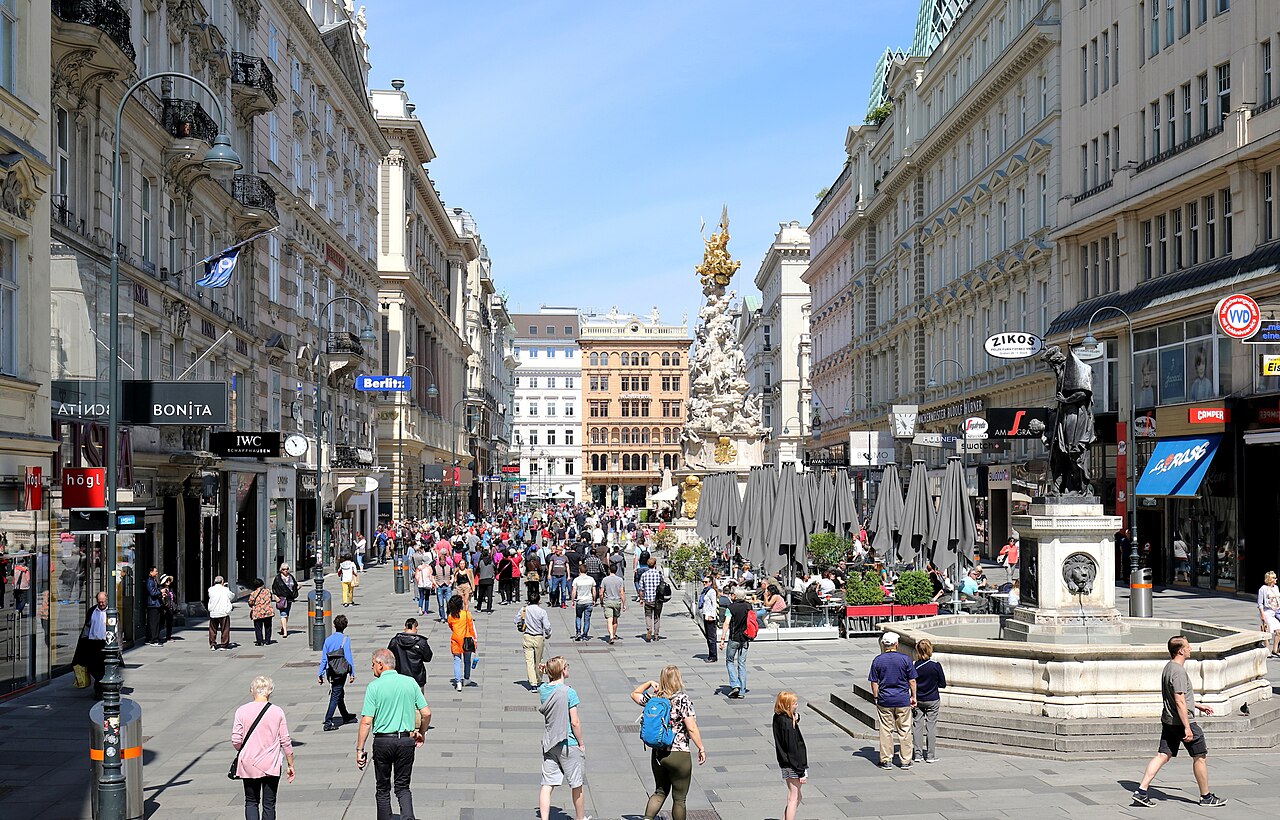
The Graben is the main pedestrian street of the Innere Stadt, running from the Stephansplatz to the Kohlmarkt and the Hofburg, and the column stands in the middle of it.
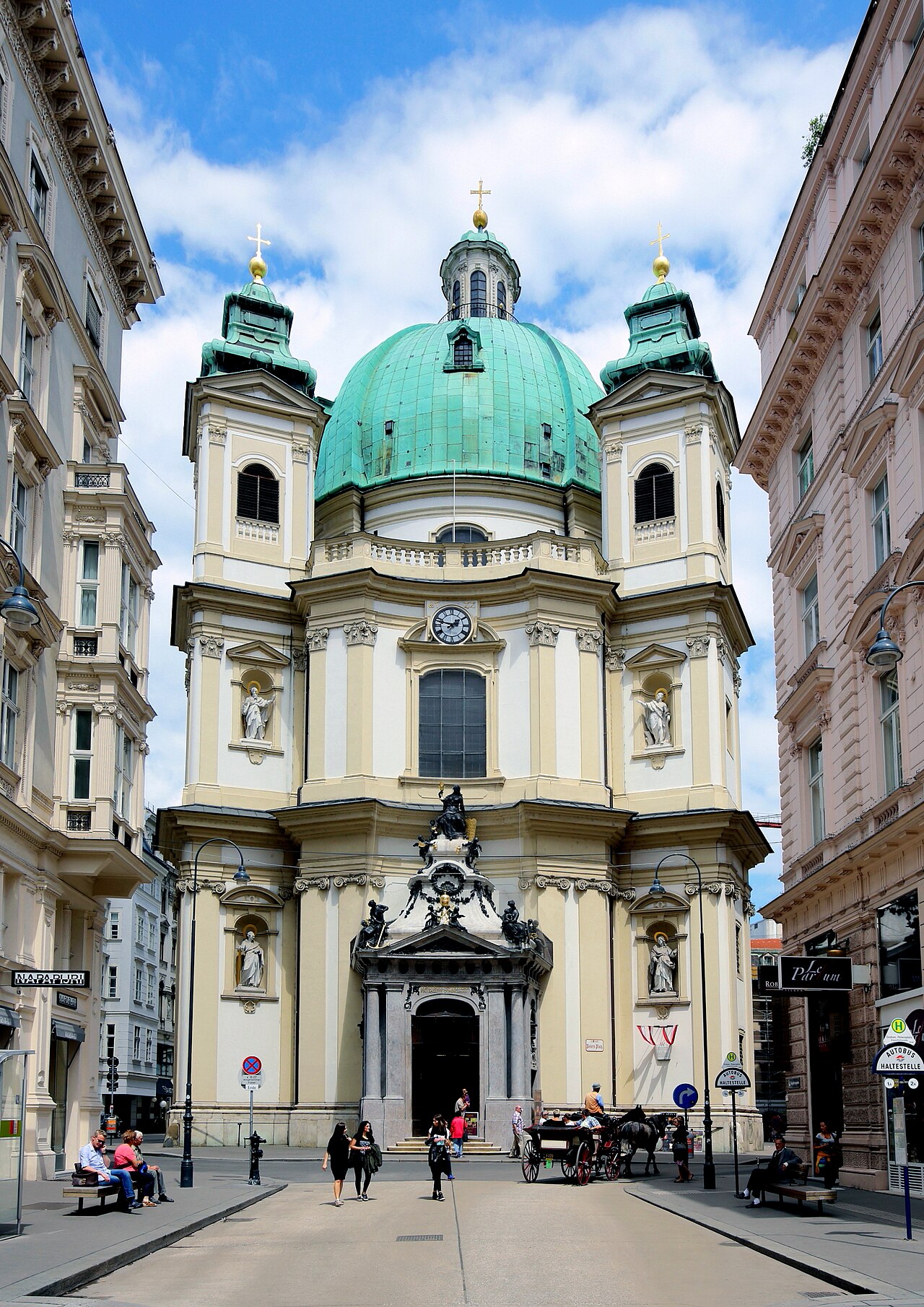
Peterskirche, a small and extremely rich Baroque church, is thirty seconds away and is free.
This is a stop rather than a destination, and it is one nobody has to plan for.
Anyone interested in what the column is actually saying should read it from the Kohlmarkt side upward: plague below, emperor kneeling above, Trinity at the top. That order is the argument.
Checked 2026-08-23 · Source
Any time. It is a street monument on a pedestrian street and it is never closed.
Early morning is the only hour the Graben is empty enough to see the column without people in front of it.
It is floodlit at night, which separates the figures from the mass of the cloud and is arguably the better view.
In December the Christmas market stalls stand around it and the base is not visible at all, which is worth knowing before planning a photograph in advent.
Checked 2026-08-23
Free. It stands in the street.
Peterskirche beside it is free. The Kaisergruft, the Hofburg and Stephansdom are each a few minutes away and each ticketed separately.
Current rates for those are not published on the sources this page uses and are not reproduced here.
Checked 2026-08-23
The 1st district, in the middle of the Graben, between the Stephansplatz and the Kohlmarkt.
Stephansplatz on U-Bahn lines U1 and U3 is two minutes east; Herrengasse on the U3 is three minutes west.
The U-Bahn has five lines and 109 stations over 83.9 km, running from about 05:00 to 01:00 and all night at weekends.
Checked 2026-08-23 · Source
There is no interpretation on site. The column is dense with meaning and carries no panel explaining any of it, which is why most people photograph it and walk on.
The Graben is the main pedestrian route through the old city and is crowded at all hours; the space around the column is not a place to stand still in December.
The costumed concert touts work this street as heavily as the Stephansplatz.
It is a monument in the open air with no facilities and no shade.
The Graben's other monument, the Josefsbrunnen and Leopoldsbrunnen fountains at either end, are regularly mistaken for parts of the same work.
Checked 2026-08-23
The column is white marble against a bright sky, which defeats automatic exposure; meter for the stone and let the sky go.
The best frame is from the Kohlmarkt end in the morning, when the sun is behind the photographer and the Graben's façades funnel the eye onto it.
The detail is where the interest is — Leopold kneeling, the angels, the plague being driven down — and it needs a long lens from across the street rather than a wide one from beneath.
At night the floodlighting reads the sculpture far better than midday sun does.
Checked 2026-08-23
A plague column raised on a vow by Leopold I after the epidemic of 1679. A wooden version went up that year and the marble one was finished in 1693 and inaugurated in 1694.
Several people. Matthias Rauchmiller conceived it and died in 1686; Johann Bernhard Fischer von Erlach designed base sculpture, Paul Strudel executed it, and the scheme came from the theatre engineer Lodovico Burnacini.
Because a theatre engineer designed it. Burnacini's cloud carrying the Trinity was the innovation, and it was copied across Austria for a century.
Leopold I. The iconography argues that the plague of 1679 and the Ottoman siege of 1683 were divine punishments lifted by the emperor's piety and prayers.
In the middle of the Graben, the main pedestrian street of the Innere Stadt, two minutes from the Stephansplatz.
No. It stands in the street, and Peterskirche thirty seconds away is free as well.
Loading the interactive map…
The interactive map could not be loaded.
Last updated:
Source: OpenStreetMap contributors, Wikidata ·