.JPG)
1 min walk · Innere Stadt
Pestsäule
- High · Heritage site
- Historic monument
Language · 11 published
Historic monument · Innere Stadt, Vienna
Reviewed by Elena Voss · Roavina Travel Editor
| Monday | 00:00 – 23:59 |
|---|---|
| Tuesday | 00:00 – 23:59 |
| Wednesday | 00:00 – 23:59 |
| Thursday | 00:00 – 23:59 |
| Friday | 00:00 – 23:59 |
| Saturday | 00:00 – 23:59 |
| Sunday | 00:00 – 23:59 |
Parsed from OpenStreetMap opening hours on 2026-09-09.
Read from the OpenStreetMap access tags; anything not listed has no tag recorded.
Set the group type to family in the planner and the day window contracts to about three quarters of a solo day.
This place is a Attraction.
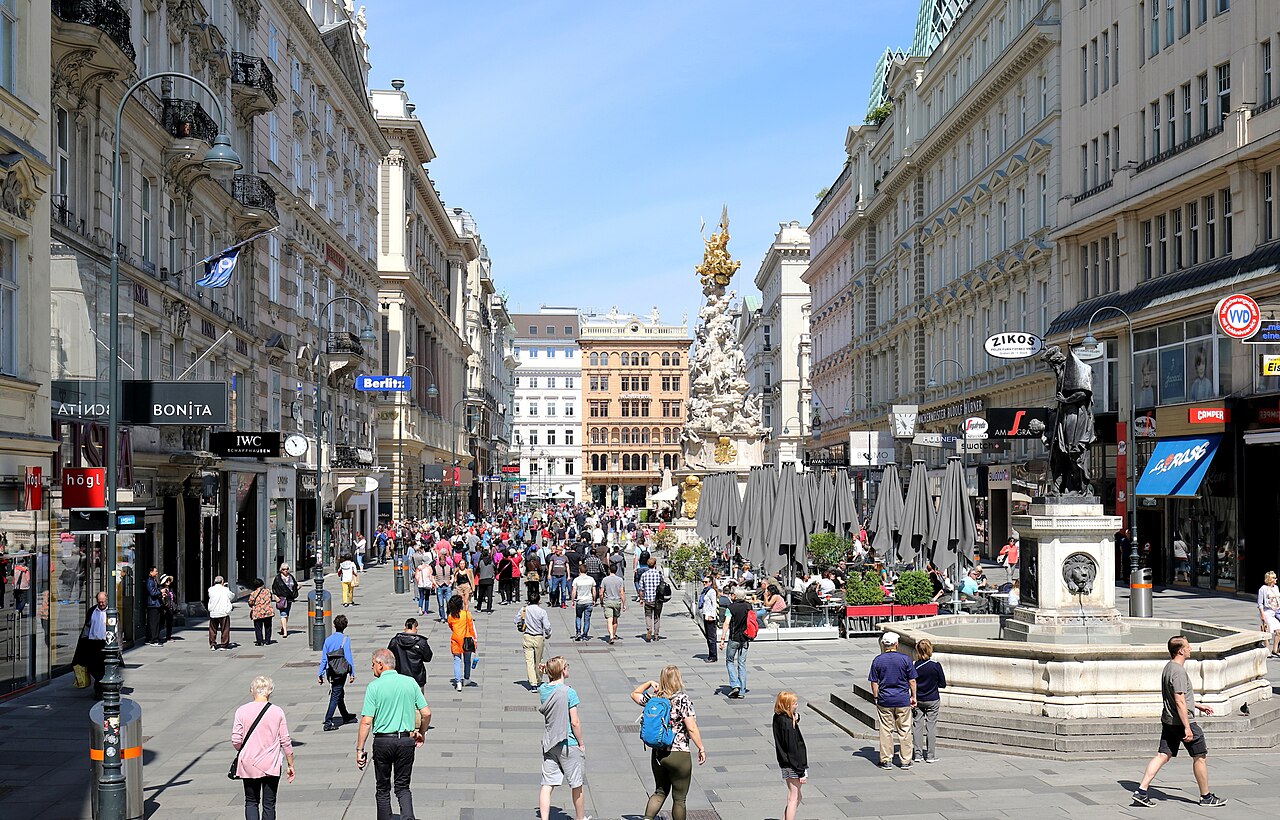
The Graben is a broad, elongated square in the Innere Stadt, and its name — 'ditch' — records what it once was: the moat of the Roman legionary camp of Vindobona, filled in during the Middle Ages and built over.
By the seventeenth century it had become one of Vienna's most fashionable addresses, and it carries the city's best-known Baroque monument, the Pestsäule, raised by Emperor Leopold I after the plague of 1679.
Today it is pedestrianised and connects Kohlmarkt to Stephansplatz, forming the spine of the old city's shopping and promenading route.
The square's odd elongated shape, wider than a typical Innere Stadt street but too narrow to be a conventional plaza, is a direct legacy of the moat it replaced.
Checked 2026-08-24 · Source
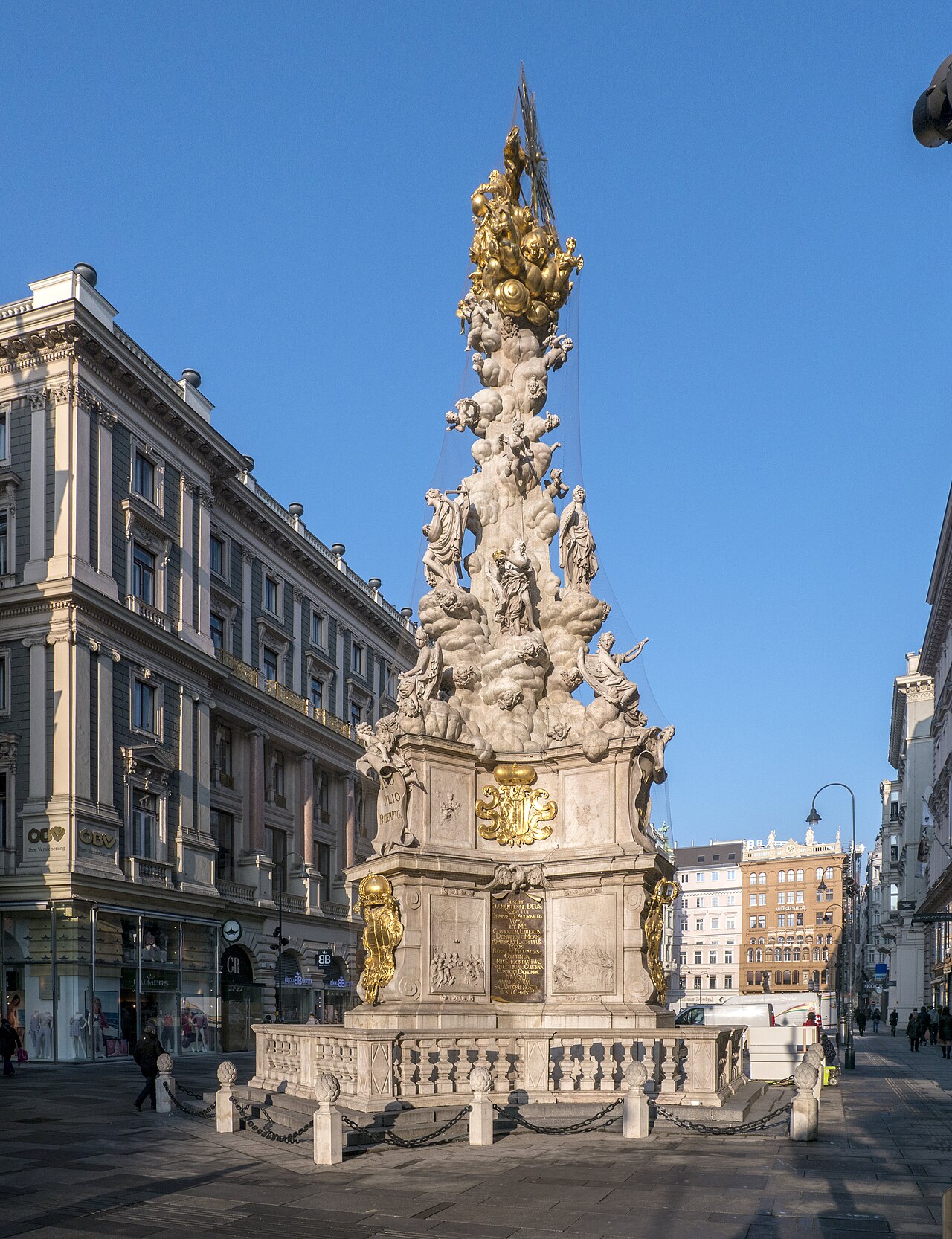
The Pestsäule dominates the square: a spiralling column of clouds and gilded figures, begun by Matthias Rauchmiller and completed after his death by Johann Bernhard Fischer von Erlach and Lodovico Burnacini, unveiled in 1693.
Two fountains flank it, the Josefsbrunnen and the Leopoldsbrunnen, each with lead statues of the two emperors' name-saints added around 1804.
The buildings lining the Graben are almost entirely late-nineteenth and early-twentieth-century commercial palaces, including Adolf Loos's American Bar just off the square on Kärntner Durchgang — a one-room interior far smaller than its reputation suggests.
At the eastern end, a small underground public toilet designed by Adolf Loos in 1905 survives as a protected piece of Jugendstil design in its own right, reached by a modest street-level entrance easy to walk past without noticing.
Checked 2026-08-24 · Source
Fifteen to twenty minutes covers the column and the two fountains at an unhurried pace; the square is small and there is no ticketed sight to slow the visit down.
Most visitors pass through it as part of a longer walk between Stephansplatz and the Hofburg rather than treating it as a destination on its own, which is the right way to see it, since the Graben is only about 150 metres long and links directly into that walking route at both ends.
Checked 2026-08-24 · Source
Early morning, before the shops open, is the only time the Graben is close to empty; by mid-morning it is one of the busiest pedestrian routes in the Innere Stadt.
December turns it into one of Vienna's central Christmas-market streets, with stalls set close along both sides of the column — atmospheric, but the crowd density triples, and reaching the column itself for a clear photograph can mean waiting for a gap in the stalls.
Outside the festive season the square keeps its usual retail rhythm, busiest from late morning through the evening shopping hours.
Sunday afternoons are quieter than any weekday, since most of the flanking shops close for the day.
Checked 2026-08-24 · Source
The square is public space with no admission charge, and the Pestsäule and fountains can be viewed at any hour, day or night.
Nothing on the Graben itself is ticketed; the nearest paid sights are the Hofburg complex a short walk to the west and St. Stephen's Cathedral to the east.
Checked 2026-08-24 · Source
Stephansplatz station (U1, U3) opens directly onto the eastern end of the Graben; it is a two-minute walk from the cathedral square.
The Herrengasse U3 stop serves the western end, near Kohlmarkt.
Several tram lines along the Ringstrasse stop within a few minutes' walk of either end, making the Graben an easy link between transport at both sides of the Innere Stadt.
Checked 2026-08-24 · Source
The Graben is a favoured pitch for costumed Mozart-ticket touts and street performers working for tips; neither is dangerous, but neither is affiliated with any official venue, and prices they quote are negotiable.
The pedestrianised surface is smooth cobble, fine for wheelchairs and pushchairs, but it does carry occasional service vehicles and delivery bikes outside shopping hours.
During the Christmas market weeks the stalls narrow the usable width of the square considerably, and pushchairs in particular can find it slow going at peak times in December.
Checked 2026-08-24 · Source
The Pestsäule is lit at night and photographs cleanly against the dark, with none of the crowd that fills the frame by day.
Standing at the Kohlmarkt end and shooting east lines the column up with the Stephansdom spire beyond it, the single most repeated composition on the square and still the one that works.
The two fountains photograph best close in, since from a distance they read as minor details against the taller column between them.
Checked 2026-08-24
Graben means ditch — the square follows the line of the moat around the Roman legionary camp of Vindobona, later filled in and built over.
The Pestsäule, a Baroque plague column raised by Emperor Leopold I after the 1679 plague and unveiled in 1693.
Matthias Rauchmiller began it; Johann Bernhard Fischer von Erlach and Lodovico Burnacini completed the design after his death.
No. It is a public pedestrian square, open at all hours, with no admission charge.
Just off the Graben on Kärntner Durchgang, a small alley connecting to Kärntner Straße.
The Josefsbrunnen and Leopoldsbrunnen, added around 1804, each carrying a lead statue of the emperors' name-saints.
Loading the interactive map…
The interactive map could not be loaded.
Last updated:
Source: OpenStreetMap contributors, Wikidata ·