
1 min walk · Innere Stadt
Schottenkirche
- Must see
- Historic monument
Language · 11 published
Historic monument · Innere Stadt, Vienna
Reviewed by Elena Voss · Roavina Travel Editor
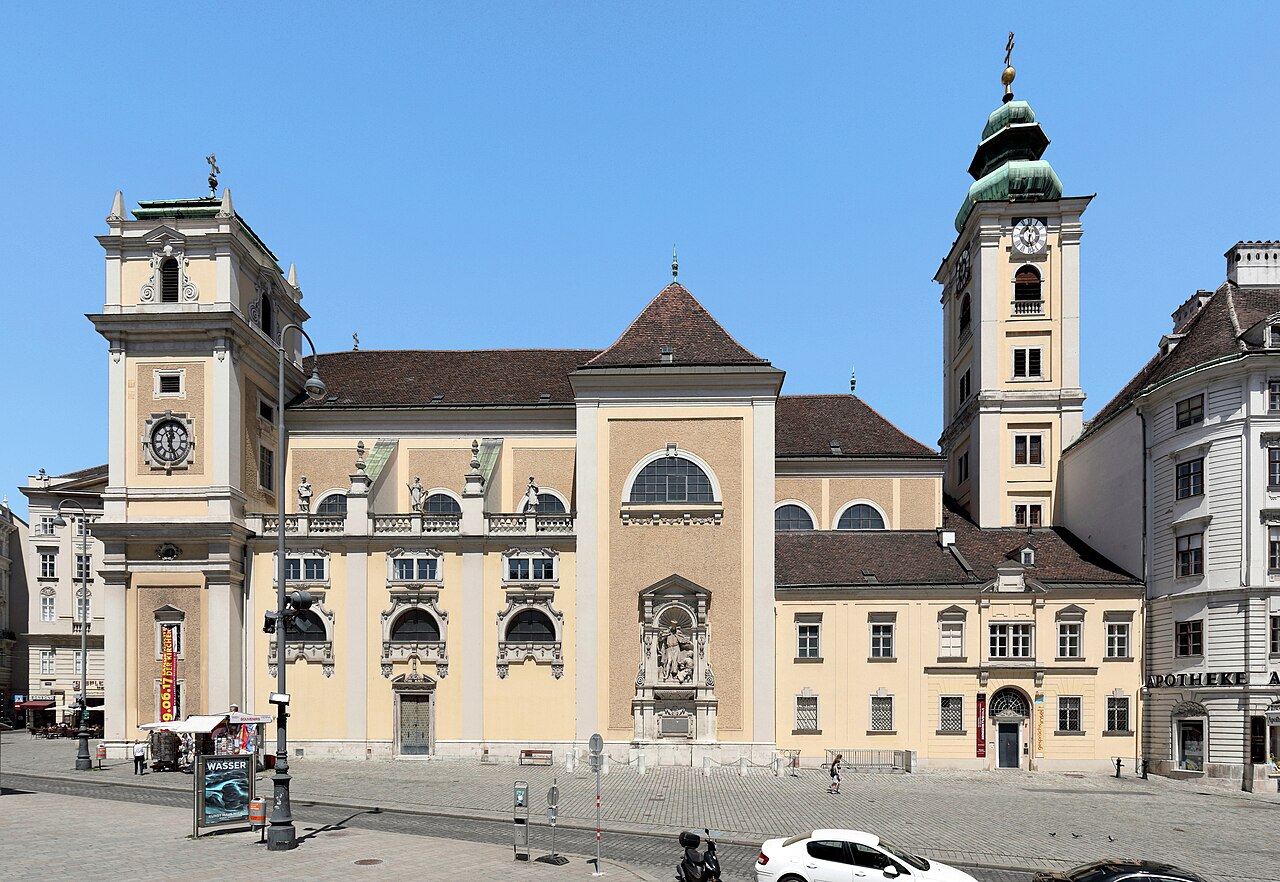
It was established in 1160. It was built in the baroque architecture style. It carries the Listed objects in Austria heritage designation.
Schottenstift is a working Benedictine abbey on Freyung square in the Innere Stadt, founded in 1155 by Duke Henry II Jasomirgott. Its name comes from the monks who first staffed it, who came from Irish and Scottish monasteries then collectively referred to in Latin as Scoti — the abbey was never founded by monks from Scotland in the modern sense, but the Gaelic monastic network of the period.
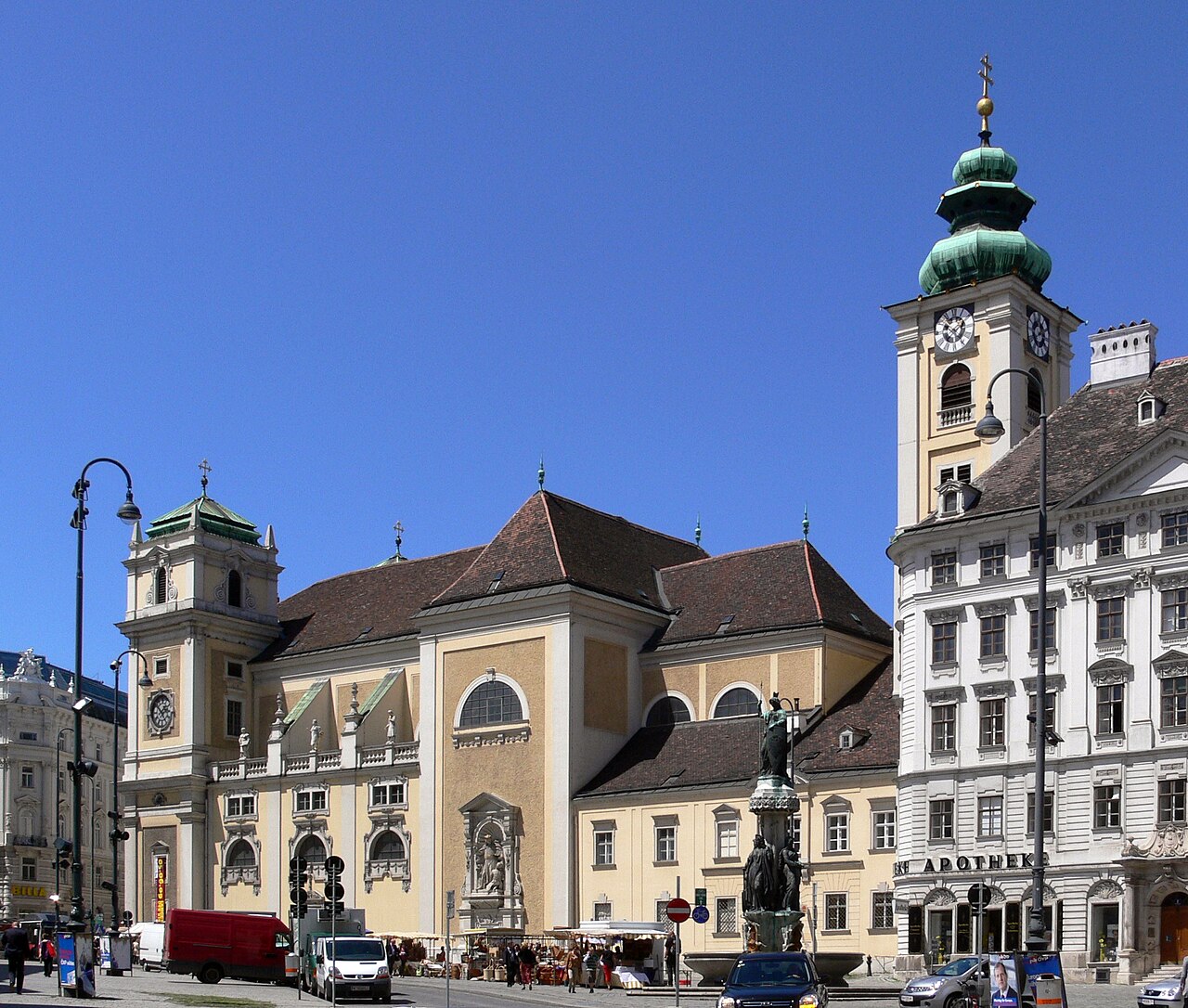
The abbey complex today combines the Schottenkirche, the abbey church rebuilt in its present Baroque form in the 17th and 18th centuries after earlier medieval and Renaissance buildings on the same site, the Museum im Schottenstift, and the attached Schottengymnasium, a school the abbey still runs.
The abbey has stood on the same site continuously since its twelfth-century founding, through Gothic and Renaissance rebuilds and a major 19th-century restoration, and it remains an active Benedictine community rather than a secularised heritage site.
Checked 2026-08-24 · Source
The Schottenkirche holds the abbey's Baroque interior, rebuilt after earlier medieval and Renaissance structures on the same footprint, and functions as a working parish and monastic church with regular services. The Museum im Schottenstift, a separate ticketed space from the church, holds the abbey's art collection, the centrepiece of which is the Schotten Altar, a winged altarpiece painted around 1469-1475 by the workshop known as the Wiener Schottenmeister — one of the most important surviving works of late Gothic panel painting from Vienna, its side panels depicting scenes from the life of the Virgin against recognisable views of the medieval city.
Checked 2026-08-24 · Source
The church itself takes fifteen to twenty minutes to see on a free visit; the Museum im Schottenstift, with the Schotten Altar and the rest of the abbey's collection, adds a further thirty to forty-five minutes on a separate visit and a separate ticket. A visitor who also wants to see the Freyung square facade and the adjoining Schottengymnasium building from outside should add a further ten minutes for a slow walk around the complex.
Checked 2026-08-24 · Source
The Schottenkirche keeps church opening hours around its services and is generally accessible on most days outside active services; the Museum im Schottenstift keeps its own, narrower opening days that this guide does not record here since museum days have shifted in the past — confirm the museum's current opening days on the abbey's own site before a visit built specifically around seeing the Schotten Altar. Freyung itself is at its quietest early on a weekday morning, before the market stalls that sometimes set up on the square draw a crowd.
Checked 2026-08-24 · Source
The Schottenkirche is free to enter as a working church. The Museum im Schottenstift charges a separate admission and this guide does not record a current price here, since it was not verified against the abbey's own page at the time of writing — the two are ticketed independently, so a church visit does not include the museum. There is no combined ticket bundling Schottenstift with any other Vienna museum.
Checked 2026-08-24 · Source
Freyung sits in the Innere Stadt a short walk from Herrengasse station on the U3, and from the Schottentor stop on the U2, the Ring tram lines and several bus routes just north of the square. It is inside Vienna's dense pedestrian core, reached comfortably on foot from most Innere Stadt landmarks, including the five-minute walk from the Hofburg or the ten-minute walk from Stephansplatz at the heart of the old city.
Checked 2026-08-24 · Source
The church and the museum keep different hours and different tickets from each other, so a visitor arriving for the Schotten Altar specifically should check the museum's own schedule rather than assuming church opening hours cover it. As an active abbey and school complex, parts of the site beyond the church and museum are not open to visitors at all. Quiet, respectful behaviour is expected in the church during services, and photography of the altar inside the museum may be restricted — check on entry.
Checked 2026-08-24 · Source
Freyung itself, with the abbey's Baroque facade closing one side of the square, is the most straightforward exterior shot and works in most daylight conditions since the square is broad and open. Inside the museum, photography of the Schotten Altar is frequently restricted to protect the pigment on a five-hundred-year-old panel painting, so this should be confirmed with museum staff on arrival rather than assumed.
Checked 2026-08-24 · Source
The Schottenstift is a functioning Benedictine monastery. While portions may be accessible, active religious institutions maintain rights to restrict visitor access. Current accessibility status is not recorded and should be confirmed before visiting.
Not in the modern sense — the name comes from Scoti, the Latin term for the Gaelic monks, from Irish and Scottish monastic houses, who staffed the abbey when Duke Henry II Jasomirgott founded it in 1155.
A winged Gothic altarpiece painted around 1469-1475 by the workshop known as the Wiener Schottenmeister, held in the Museum im Schottenstift and regarded as one of the most important surviving works of late Gothic panel painting produced in Vienna.
No. The Schottenkirche is a free-to-enter working church; the Museum im Schottenstift is a separate space with its own hours and its own admission.
Yes. It has been a working Benedictine community continuously since its twelfth-century founding and still runs the attached Schottengymnasium school.
Herrengasse on the U3 is a short walk south of Freyung, and Schottentor on the U2 sits just north of the square.
Loading the interactive map…
The interactive map could not be loaded.
Last updated:
Source: OpenStreetMap contributors, Wikidata ·