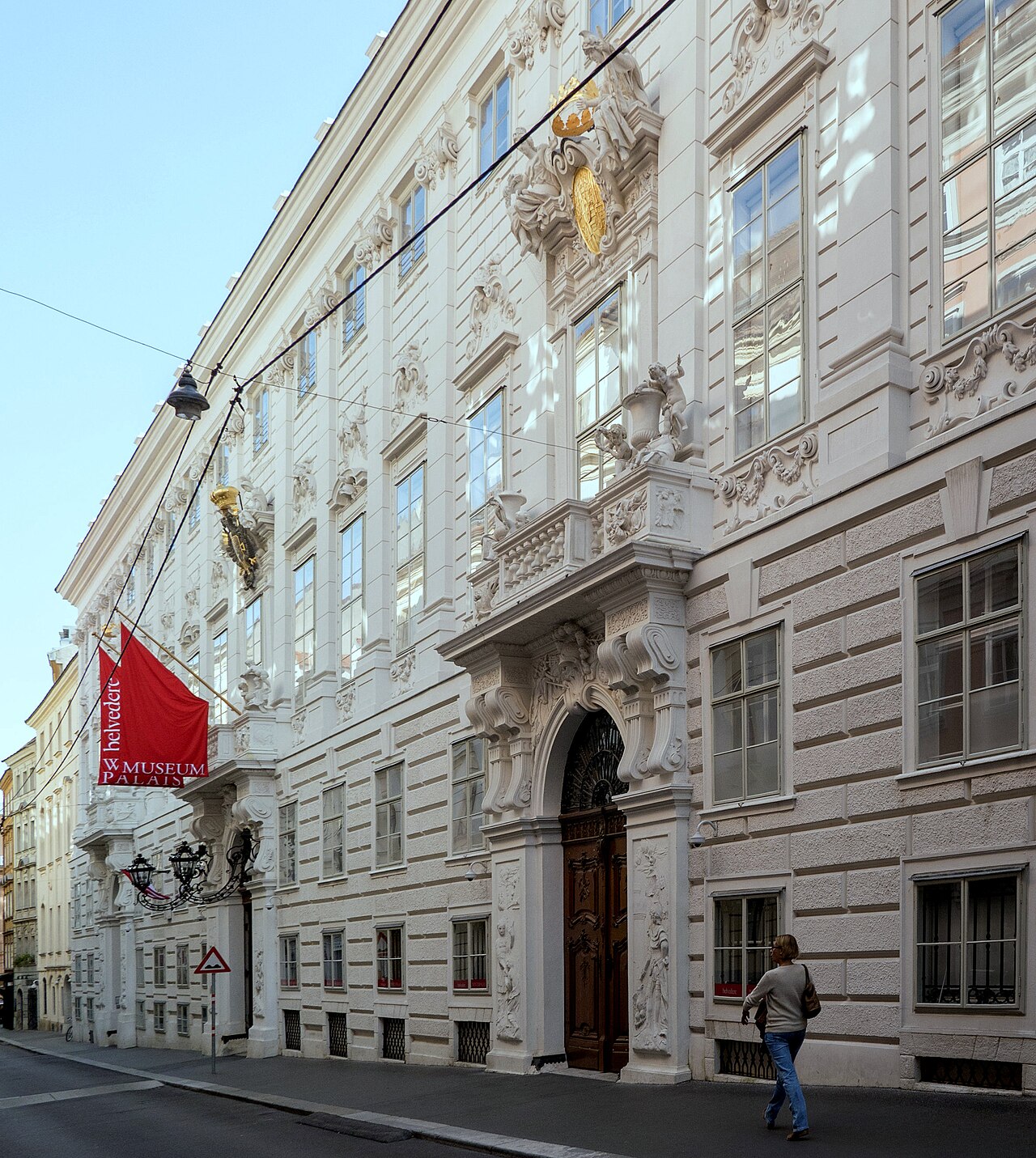
The Winter Palace of Prince Eugene (Winterpalais des Prinzen Eugen) is a Baroque town palace at Himmelpfortgasse 8 in Vienna's first district, built between 1695 and 1724 as the city residence of Prince Eugene of Savoy, the Habsburg field marshal who broke the Ottoman siege lines at the Battle of Zenta.
Johann Bernhard Fischer von Erlach designed the first, narrower building in 1695; Johann Lukas von Hildebrandt then took over and widened it westward in three further campaigns, giving the palace its telamon-flanked entrance on Himmelpfortgasse and its sequence of state rooms. Eugene used it as his winter residence, keeping his larger Belvedere for summer entertaining.
After Eugene's death in 1736 the palace passed through several owners before the Austrian state bought it in 1848 to house the Ministry of Finance, which still occupies the building today — the palace has been a working government office for longer than it was ever a private residence.
The ground floor and staircase carry Hildebrandt's Baroque decoration largely intact: the grand staircase is guarded by Lorenzo Mattielli's Herculean telamons, muscular stone figures that support the vaulting rather than merely flanking the doorway, a motif that became a signature of Viennese palace architecture after this building.
The piano nobile holds the Prunkräume, the ceremonial state rooms — the Blue Salon, the Gold Cabinet and Eugene's former bedchamber — with stucco ceilings by Marcantonio Chiarini and Santino Bussi. These rooms are Ministry of Finance function space today, not a permanent display, so what a visitor sees depends entirely on whether an exhibition or guided opening is currently running.
The upper floors, where ministry staff work daily, are not part of any visitor route at any time.
A guided tour of the Prunkräume, when one is running, takes about 60 to 75 minutes and covers the staircase and the state rooms only — the working ministry floors are never on the route. There is no self-guided visit, and no shorter walk-through option exists, since a guide is required to move a group through a working government building at all.
The palace has no year-round public opening, so "when to go" means checking the current exhibition or open-day calendar before travelling rather than choosing a season. Openings, when they occur, have historically run as timed guided tours on set weekdays; there is no crowd pattern to plan around because there is no standing queue.
There is no standing museum ticket for the Winterpalais: the building is a working government ministry and the state rooms open to visitors only during scheduled exhibitions or guided-tour programmes organised in cooperation with Vienna's museums, most often the Belvedere. Whether a programme is currently running, and its price, is not recorded here — confirm on the Federal Ministry of Finance's own site (bmf.gv.at) or the Belvedere's exhibition calendar (belvedere.at) before planning a visit, since neither ticketing aggregator nor a fixed admission price can be quoted honestly for a building without regular hours.
Himmelpfortgasse 8 sits a few steps off Kärntner Straße, between the State Opera and Stephansplatz. The U1, U3 and U4 lines all converge at Stephansplatz, an eight-minute walk, and the Karlsplatz U1/U2/U4 station is a similar distance to the south. Tram lines 1, 2, 62 and D stop at Kärntner Ring/Oper, two minutes closer than either U-Bahn station. The street itself is pedestrian and unmarked from outside as anything but an office building, so the small palace plaque by the entrance is the only street-level sign.
The single biggest trap is arriving with no open programme running: because there is no permanent museum, a visitor who has not checked the current schedule finds a functioning ministry building with security at the door and no public access at all.
When a guided opening is running, it is timed-entry and typically capped in group size, so a walk-up without a reservation can still be turned away even during an active programme. Photography and bag-carrying rules follow whichever institution is running the tour that season rather than a fixed palace policy.
The Mattielli telamons on the staircase are the most photographed detail and are visible from the entrance hall even outside a scheduled tour, since the vestibule sits just past the street door on the ministry's public-access side. Photography inside the Prunkräume themselves is governed by whichever exhibition is on and is not guaranteed; tripods and flash are routinely refused in staterooms this densely stuccoed regardless of the operator, to protect the surfaces.
Can the public visit the Winterpalais at any time?
No. The building is the seat of Austria's Federal Ministry of Finance and opens to visitors only during scheduled exhibitions or guided-tour programmes, not on a standing daily basis.
Who built the Winterpalais?
Johann Bernhard Fischer von Erlach designed the first, narrower building in 1695; Johann Lukas von Hildebrandt then widened it in three later campaigns for Prince Eugene of Savoy.
Why did Prince Eugene need both the Winterpalais and the Belvedere?
The Winterpalais in the city centre was his winter residence and administrative base; the larger Belvedere complex, set in gardens outside the old walls, was built later for summer entertaining.
What happened to the palace after Prince Eugene died?
It changed hands among Habsburg and noble owners after his death in 1736 until the Austrian state purchased it in 1848 to house the Ministry of Finance, its occupant ever since.
Are the Herculean telamons on the staircase original?
Yes. They were carved by Lorenzo Mattielli as part of Hildebrandt's building campaign and remain in place on the grand staircase today.
Is there a fixed admission price for the Winterpalais?
No fixed price is published because there is no standing museum operation; admission, when a tour programme runs, is set by whichever institution is organising it that season.