3 min walk
Piazza Mattei
- Must see
- Activity
Language · 11 published
Historic monument · Rome
Largo di Torre Argentina
Reviewed by Elena Voss · Roavina Travel Editor
This place is a Attraction.
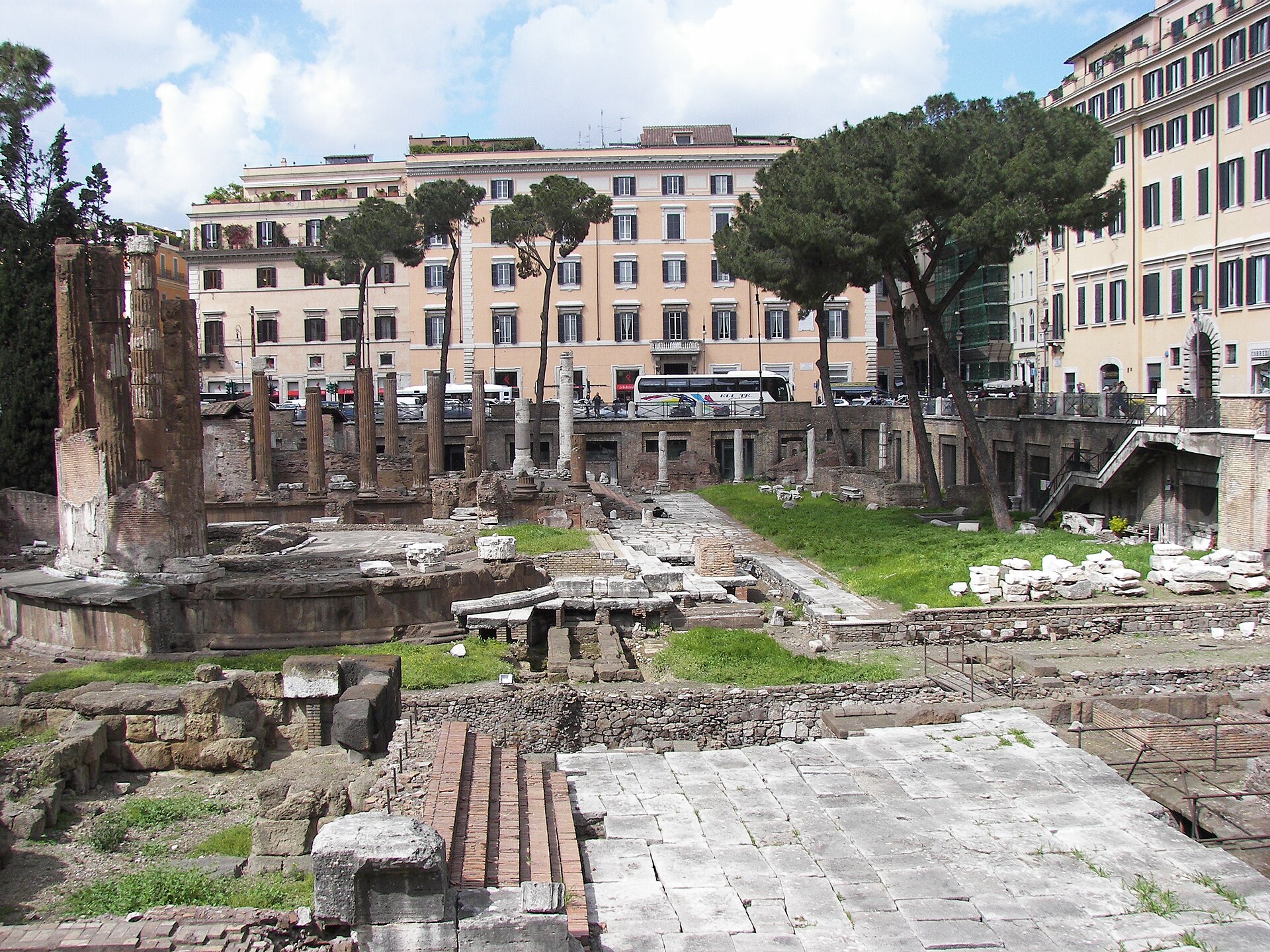
Largo di Torre Argentina is a square in Rome that contains the remains of four Republican-era temples and the Theatre of Pompey. The ruins were uncovered during demolition work in the 1920s. The site is historically significant as the location where Julius Caesar was assassinated in 44 BCE. The temples date from the fourth to second centuries BCE. The square takes its name from the Torre Argentina, a tower erected by the papal diplomat Johannes Burckardt. The area is now also known for its cat sanctuary.
Checked 2026-08-26
The site contains four temple ruins designated A, B, C, and D by archaeologists. Temple B, the most intact, has a circular plan with six surviving columns. Temple A is rectangular with a high podium. Temple C is the oldest, while Temple D remains largely unexcavated beneath the street level. The curia of Pompey, where Caesar was killed, lies within the complex. The cat sanctuary occupies part of the excavated area at ground level. Informational signage around the perimeter provides context for visitors viewing from the surrounding pavement.
Checked 2026-08-26
Viewing the ruins from the surrounding street level requires approximately fifteen to thirty minutes for a casual visit. Visitors interested in reading all informational signage and examining architectural details may spend forty-five minutes to one hour. The site is compact, with the excavated area visible from multiple angles around the perimeter. There is no interior access to the temple ruins themselves. Photography and observation from the railings constitute the primary activities. The adjacent streets offer additional points of interest for extended exploration of the surrounding historic center.
Checked 2026-08-26
The square is an open public space accessible at street level at all times, though visibility of ruins varies with natural light conditions. Daylight hours offer optimal viewing of architectural details. Evening artificial illumination may be present but is not guaranteed. Weather conditions affect comfort but not access to the perimeter viewing areas. The site is outdoors and exposed. Crowds tend to be largest during midday hours and diminish in early morning and evening. Seasonal tourism patterns in Rome apply. Check the operator's own site for the travel date before relying on a schedule or fare.
Checked 2026-08-26
Viewing the ruins from the surrounding public pavement is free of charge as of general understanding. No ticketed entry to the excavated area below street level is available to the general public. The cat sanctuary accepts voluntary donations. Any future changes to access arrangements would require verification from official sources. Visitors should not rely on unverified information regarding potential entrance fees. The surrounding square remains a public thoroughfare without controlled access points requiring payment. Check the operator's own site for the travel date before relying on a schedule or fare.
Checked 2026-08-26
Largo di Torre Argentina sits in Rome's historic center, accessible by multiple bus lines serving Corso Vittorio Emanuele II and adjacent streets. The nearest metro stations are not immediately adjacent; Barberini and Colosseo require additional walking or bus connection. Walking from Piazza Venezia, the Pantheon, or Campo de' Fiori is feasible for mobile visitors. The area is pedestrian-dense with limited vehicle access. Taxis and ride services can approach nearby but may face traffic restrictions. Cycling is possible but challenging in congested central streets. Signage from major landmarks is generally adequate for orientation.
Checked 2026-08-26
The perimeter railings are the only barrier to the excavated area; visitors with children should exercise caution. The surrounding streets are busy with traffic and require alertness when crossing. Pickpockets operate in this high-tourist zone. The pavement around the square is uneven in places. There is no shelter from sun or rain at the viewing points. The cat sanctuary entrance is separate from the archaeological viewing area. Claims about guided descent into the ruins should be verified with official sources. Street vendors and costumed characters nearby may be persistent. Evening lighting may be insufficient for detailed observation.
Checked 2026-08-26
Photography from the public perimeter is unrestricted. The railings provide vantage points for downward angles of the temple ruins. Wide shots capturing multiple temples require positioning at square corners. Morning and afternoon light create different shadow effects on the stone surfaces. Tripods may attract attention in crowded conditions and obstruct pedestrian flow. The depth of the excavated area challenges flash effectiveness. The cat sanctuary area has separate boundaries. Night photography depends on available artificial lighting. Drone use would require compliance with Italian aviation regulations and is impractical in dense urban airspace. Reflections and glare affect midday shooting.
Checked 2026-08-26
General public access to the excavated area below street level is not available. Viewing is restricted to the perimeter railings.
Viewing from the public pavement is free. No ticketed entry system operates for the archaeological zone.
A volunteer-run sanctuary for stray cats occupies part of the site at ground level. It is separate from the archaeological viewing area.
Official guided descent into the ruins is not standardly available. Any claims of access should be verified with authoritative sources.
The curia of Pompey within the complex is identified as the location of Caesar's assassination in 44 BCE.
The Pantheon, Piazza Venezia, and Campo de' Fiori are within walking distance in the historic center.
Loading the interactive map…
The interactive map could not be loaded.
Last updated:
Source: OpenStreetMap contributors, Wikidata ·