
7 min walk
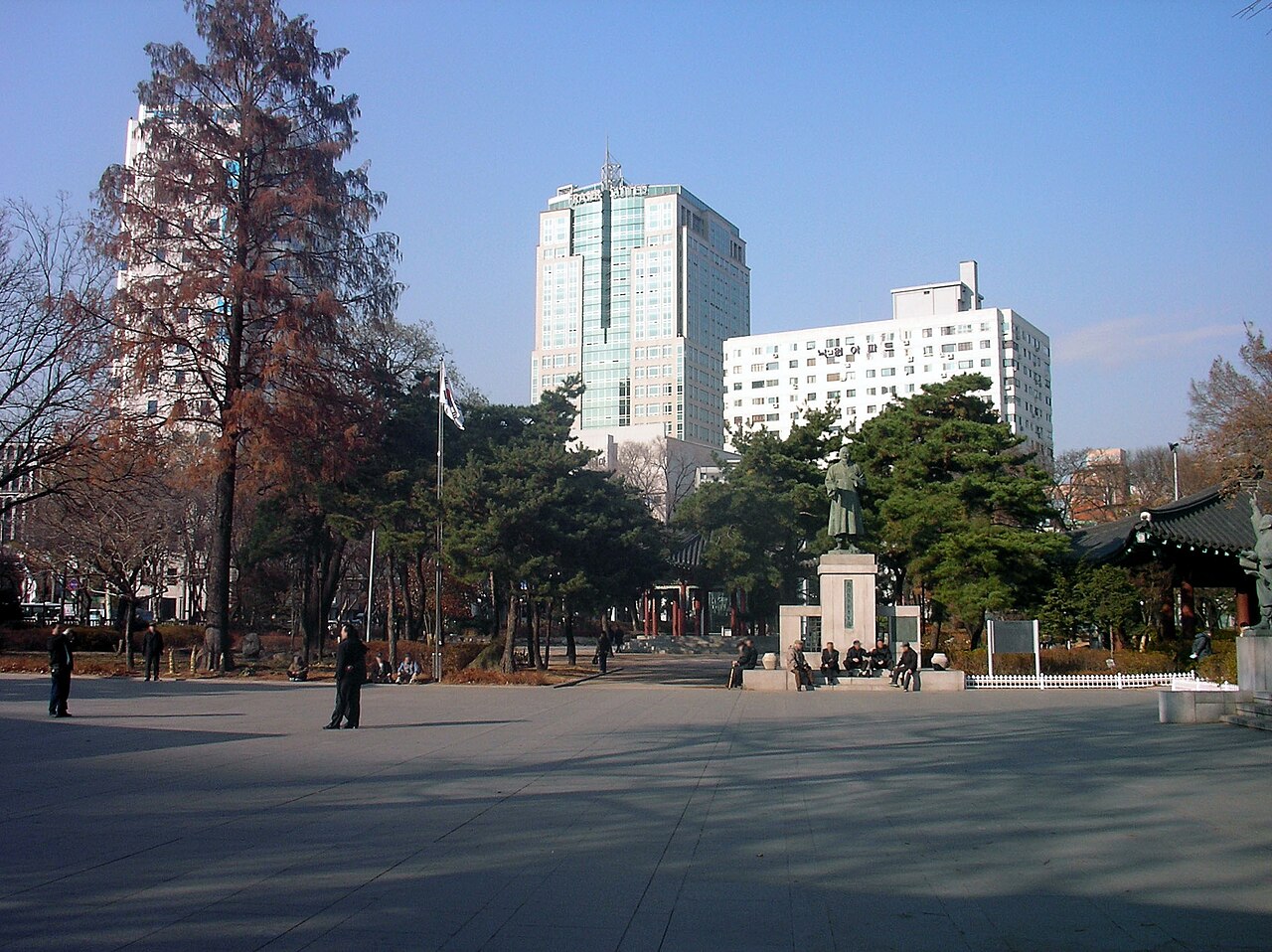
Tapgol Park
- Must see · Heritage site
- Nature site
Language · 11 published
Nature site · Seoul
청계천공원
Reviewed by Elena Voss · Roavina Travel Editor
| Monday | 00:00 – 23:59 |
|---|---|
| Tuesday | 00:00 – 23:59 |
| Wednesday | 00:00 – 23:59 |
| Thursday | 00:00 – 23:59 |
| Friday | 00:00 – 23:59 |
| Saturday | 00:00 – 23:59 |
| Sunday | 00:00 – 23:59 |
Checked 2026-08-31 · Source
Read from the OpenStreetMap access tags; anything not listed has no tag recorded.
Set the group type to family in the planner and the day window contracts to about three quarters of a solo day.
This place is a Attraction. It carries the Historic sites of South Korea heritage designation.
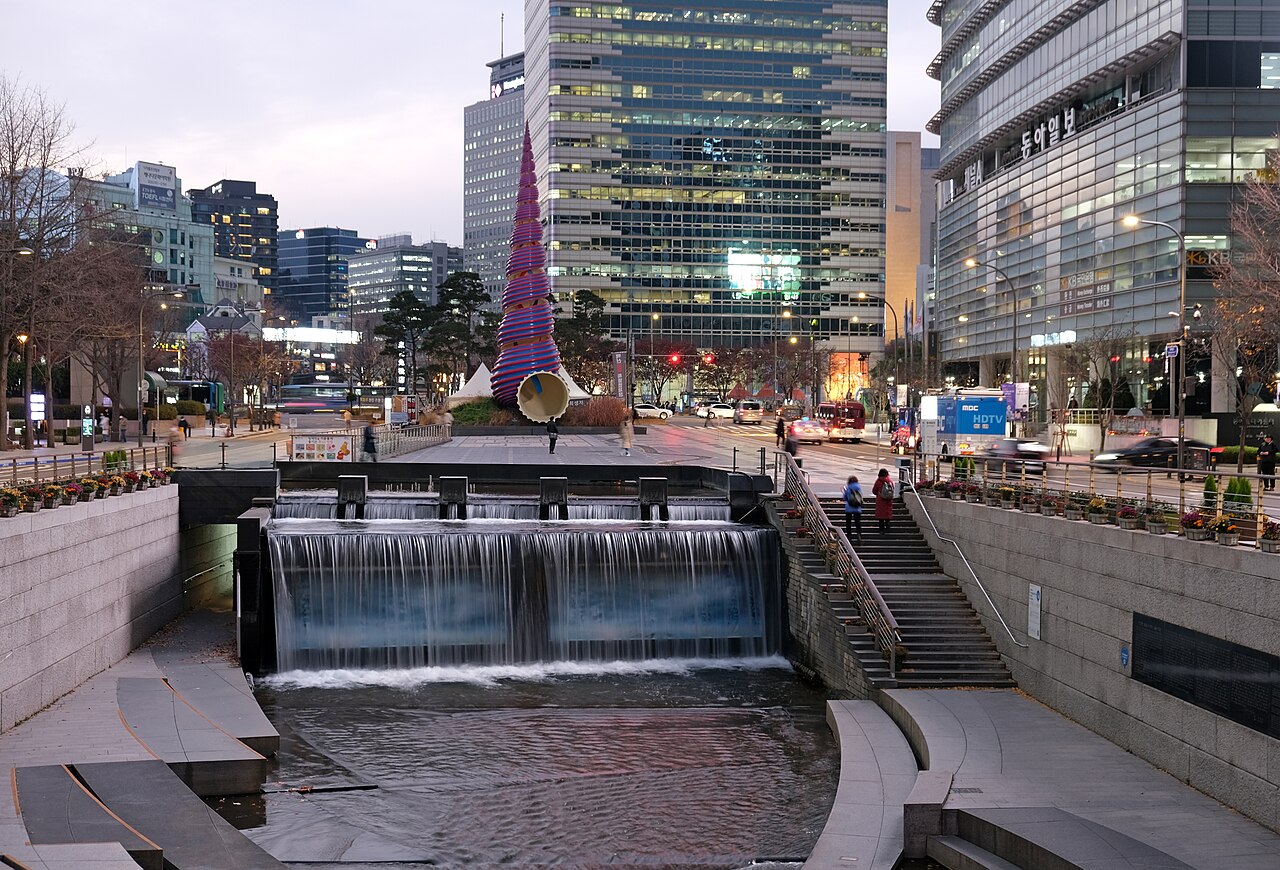
Cheonggyecheon is an 11-kilometre stream running through the middle of Seoul, sunk a storey below street level between Cheonggye Plaza and the Hangang River. Seoul's official tourism office describes it as a restoration of a stream that ran here during the Joseon Dynasty, covered over after the Korean War and then buried under an elevated highway as the country rebuilt. In 2003 the highway was removed and the stream was restored to the form a visitor walks today. That history explains why the place does not read like an old waterway: the banks are engineered, the water level is managed, and the whole corridor is a piece of city planning that happens to be pleasant to walk.
Checked 2026-08-31 · Source
The stream is one continuous walkway with its interest unevenly distributed. The western end at Cheonggye Plaza is the formal one: the plaza is run as a cultural arts venue, the water begins here as a designed cascade, and this is where the crowds are thickest. From there the channel runs below the traffic for several kilometres through the Jongno and Euljiro streets, walled in stone and concrete with the city stacked directly above it. Stepping stones cross the water at intervals, set low and close enough that a crossing takes a few strides rather than any nerve.
Checked 2026-08-31 · Source
Allow ninety minutes. Neither Seoul's tourism office nor the stream's operator publishes a suggested visit length, so ninety minutes is this guide's judgement rather than a figure read off an official page, and it is built around what is actually walkable. The stream is 11 kilometres end to end and nobody on a short trip to Seoul should attempt all of it. Ninety minutes covers the western stretch, from Cheonggye Plaza east through the first several bridges, at a pace that leaves room to stop at the stepping stones, watch the water and climb out at a subway station of the visitor's choosing.
Checked 2026-08-31 · Source
Open 24 hours daily, seven days a week. No scheduled closure days. Stream-level access is temporarily restricted during rain or flood risk and reopens after hazards are removed and cleaning is completed. Individual fountains and media installations follow separate seasonal schedules. The promenade is open 24 hours a day, seven days a week, so the choice is about light, heat and company rather than about opening times. The one documented restriction is weather: Seoul's tourism office states that access may be restricted for safety reasons in the case of rain, and that is not a formality, because the walkway sits a storey below the road inside a channel built to take storm water.
Checked 2026-08-31 · Source
Free general admission; no entrance ticket is required for the stream promenade. There is no ticket to record here, and no price either. Cheonggyecheon is a public promenade rather than a gated attraction: a visitor walks down from the street and walks along it. Seoul's official tourism page for the stream carries a telephone number, an address, a transport note and an accessibility list, but no admission field and no figure of any kind, so this guide records no fee for it. An admission price was not found on any operator page, and none is invented here. What the operator does state is that the promenade is open around the clock every day of the week, with access possibly restricted in rain.
Checked 2026-08-31 · Source
For the Cheonggye Plaza end, use City Hall Station on Subway Lines 1 or 2, Exit 4; the official listing gives a walking distance of 384 metres. The stream is also connected to ten other named stations along its route, including Jonggak, Jongno 3-ga, Dongdaemun, Dongmyo, Euljiro 1-ga and Yongdu. This is the named approach for an independent visit. No car is needed, and a car is a liability here: the stream runs under some of central Seoul's most congested streets and there is nowhere at the water to leave one.
Checked 2026-08-31 · Source
Seventeen sloped entrances accommodate wheelchairs and pushchairs. Two elevators connect street level with the promenade: one between Supyogyo and Samilgyo, and one between Yeongdogyo and Hwanghakgyo. The remaining 36 entrances are stair-only, so step-free access depends on the chosen entry point. The access description applies to the documented visitor route. Rain is the real hazard and the only one the operator names. The walkway sits inside a channel that carries storm water, and Seoul's tourism office states that access may be restricted for safety reasons when it rains, so treat a heavy shower as an instruction to climb out at the next bridge rather than as an inconvenience to walk through.
Checked 2026-08-31 · Source
The picture most people come for looks along the water with the road-level city stacked above it, and it works because the channel is straight, the banks are hard-edged and the buildings rise directly out of them. Stand on a bridge rather than beside the water: from the parapet the stream runs away in a line and the next bridge frames the far end, which is the composition the place is built for.
Checked 2026-08-31 · Source
The downtown stream route is approximately 11 kilometres long, beginning at Cheonggye Plaza and continuing beneath 22 bridges toward the Hangang River.
It operates from April 1 through November 15, from 12:00 to 21:00, running for 50 minutes and stopping for 10 minutes each hour.
Water can rise rapidly and submerge the trail. Access is restricted during dangerous conditions, and visitors must leave through the nearest exit rather than shelter beneath a bridge.
Bicycles and roller skates are prohibited. Animals are also prohibited, except service dogs accompanying people with disabilities.
Ramp entrances are provided at Mojeongyo, Sewungyo, Beodeuldari, Dasangyo, Biudanggyo, Dumuldari and Gosanjagyo; two additional locations have elevators.
The operator supplies about 40,000 tonnes of treated Hangang River water on an ordinary day, with capacity rising to 120,000 tonnes.
Loading the interactive map…
The interactive map could not be loaded.
Last updated:
Source: OpenStreetMap contributors, Wikidata ·