

2 min walk
Alfredo alla Scrofa
- Restaurant or café
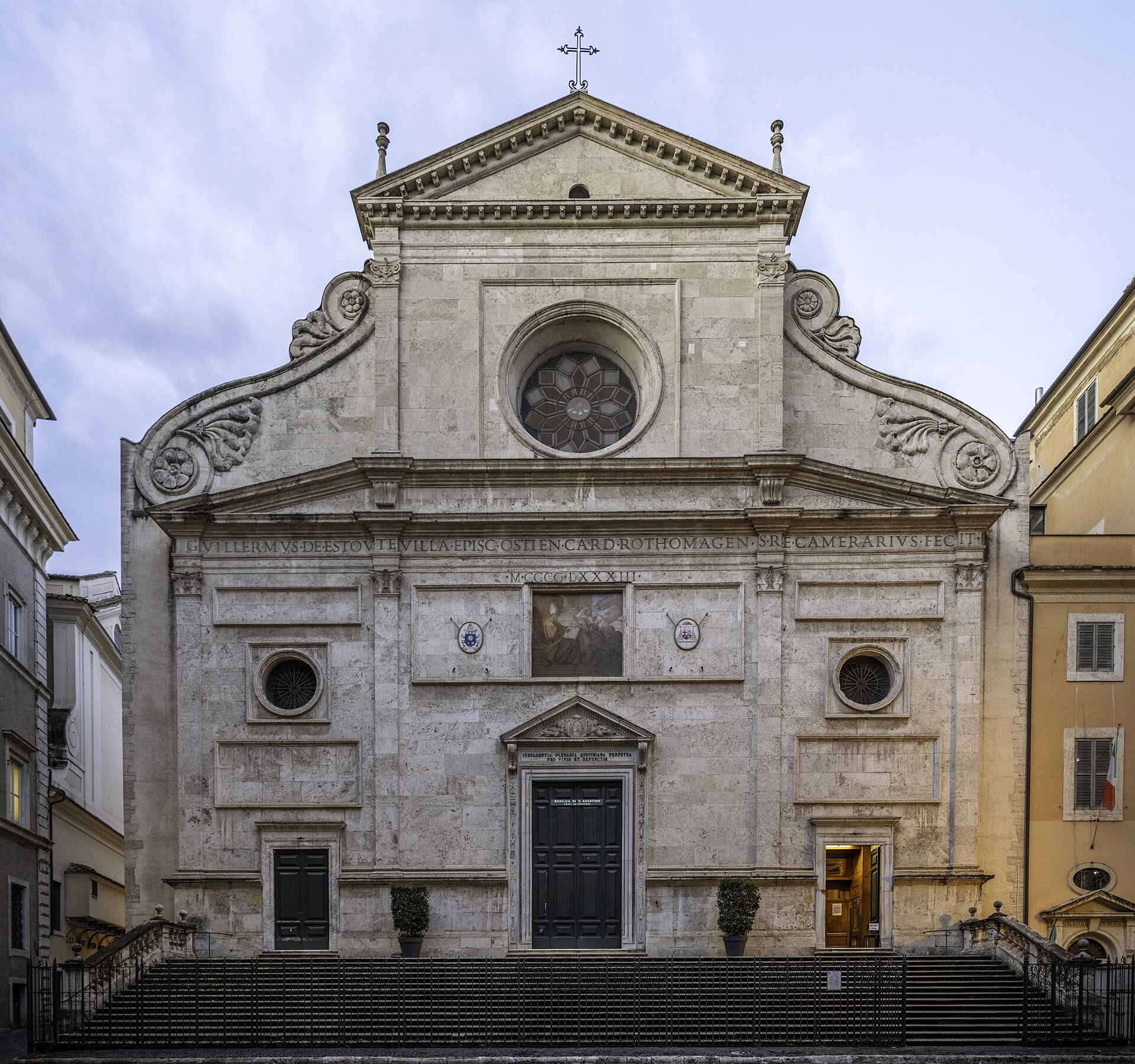
Place of worship · Rome
Basilica di Sant'Agostino
| Monday | 07:30 – 19:30 |
|---|---|
| Tuesday | 07:30 – 19:30 |
| Wednesday | 07:30 – 19:30 |
| Thursday | 07:30 – 19:30 |
| Friday | 07:30 – 19:30 |
| Saturday | 07:30 – 19:30 |
| Sunday | 08:00 – 19:30 |
Closed to visitors between 12:30 – 16:00
Closed to visitors between 12:45 – 16:00
Parsed from OpenStreetMap opening hours on 2026-09-09.
The Basilica of Saint Augustine, or Basilica di Sant'Agostino, is a Roman Catholic church near Piazza Navona in Rome's historic centre. Dedicated to Saint Augustine of Hippo, it sits within the Campo Marzio district's dense collection of historic religious buildings. It is both a functioning church and a quiet cultural stop between major central landmarks. The Basilica of Saint Augustine, locally named Basilica di Sant'Agostino, is a Roman Catholic church in Rome. It stands near the Piazza Navona in the historic centre. The basilica is dedicated to Saint Augustine of Hippo, the influential theologian and philosopher. The building occupies a significant position within Rome's dense network of historic religious structures. Visitors encounter it as an active place of worship integrated into the urban fabric of the Campo Marzio district. Yes. Basilica di Sant'Agostino is the local Italian name for the Basilica of Saint Augustine. Yes. Basilica di Sant'Agostino is the Italian name for the Basilica of Saint Augustine in Rome.
Checked 2026-08-26 · Source
The basilica offers the atmosphere and furnishings of a working Roman church, including an altar, chapels, devotional spaces, artworks, tombs and memorials. Rather than rushing through, pause to read the room as a place of worship woven into the city. Its interior suits visitors interested in Roman religious art and church architecture. The interior contains artworks and decorative elements typical of Roman church architecture. The basilica houses tombs and memorials connected to its religious function. Visitors should expect standard ecclesiastical furnishings: altar, chapels, and devotional spaces. The building serves both liturgical purposes and cultural interest for those studying Roman baroque and later religious art traditions.
Checked 2026-08-26 · Source
Set aside roughly thirty to sixty minutes for the interior. That is enough time to enter respectfully, view the altar and chapels, notice the artworks and absorb the basilica's devotional character. Its location makes it easy to pair with Piazza Navona, creating a natural walking sequence through the historic centre. Visitors exercising cautious judgement should allocate time comparable to other medium-sized Roman basilicas, perhaps thirty to sixty minutes for interior observation. Those with specific artistic or devotional interests may require longer. The absence of recorded guided tour schedules or audio facilities means self-directed pacing. Consider combining this visit with nearby Piazza Navona attractions. Allow flexibility for possible religious services affecting access.
Checked 2026-08-26 · Source
Plan this stop around its role as an active parish church. Religious services can affect visitor movement and the atmosphere inside. Morning or late-afternoon light may help with interior viewing, while the surrounding Piazza Navona area is lively throughout the day. A weekday visit can fit comfortably into a quieter central-Rome walk. Visitors must independently verify opening times before travel. The basilica functions as an active church, so religious observances may restrict tourist access during services. Morning and late afternoon visits often prove practical at Roman churches, though this general pattern does not constitute confirmed scheduling. Seasonal variations in daylight affect interior visibility for art appreciation. Summer heat and winter closure possibilities for restoration are factors requiring advance verification.
Checked 2026-08-26 · Source
The basilica is an active parish church, and the visit centres on its religious interior rather than a ticketed attraction. Roman churches commonly welcome visitors without a mandatory admission charge, while voluntary offerings support church life and maintenance. Enter as a worshipper would: quietly, modestly dressed and with consideration for services. As an active parish church, admission is typically free at Roman basilicas, though this pattern does not guarantee current policy.
Checked 2026-08-26 · Source
The basilica is close to Piazza Navona in the pedestrian-oriented historic centre. Walking from Piazza Navona or the Pantheon is the most natural way to arrive and lets you continue among central Rome's streets. Buses run along larger nearby roads, but exact routes vary. Taxis can approach the area, though restricted streets limit direct access.
Checked 2026-08-26 · Source
Wear respectful clothing covering shoulders and knees. Services can interrupt sightseeing, and quiet behaviour matters inside. Historic floors may be uneven or dimly lit, so move carefully. The streets around Piazza Navona attract many visitors; keep bags and phones secure. If you are planning a longer walking day, arrange rest and refreshments before entering the church.
Checked 2026-08-26 · Source
Treat photography as secondary to worship. Work quietly, avoid flash and lower the camera during services or devotional moments. The interior may be dim, so steady framing is more useful than intrusive equipment. Focus on the overall arrangement of altar, chapels and decorative surfaces, while leaving worshippers and memorial spaces undisturbed.
Checked 2026-08-26 · Source
Yes. Basilica di Sant'Agostino is the Italian name for the Basilica of Saint Augustine in Rome.
It stands near Piazza Navona in Rome's historic centre, within the Campo Marzio district.
Allow about thirty to sixty minutes for the altar, chapels, artworks, memorials and the atmosphere of the working church.
The basilica is an active church, so services take priority. Visitors should remain quiet and avoid interrupting worship.
The interior contains an altar, chapels, devotional spaces, artworks, tombs and memorials connected with its religious function.
Dress modestly, speak softly, respect worshippers and treat photography as secondary to religious services and devotional activity.
Loading the interactive map…
The interactive map could not be loaded.

Last updated:
Source: OpenStreetMap contributors, Wikidata ·