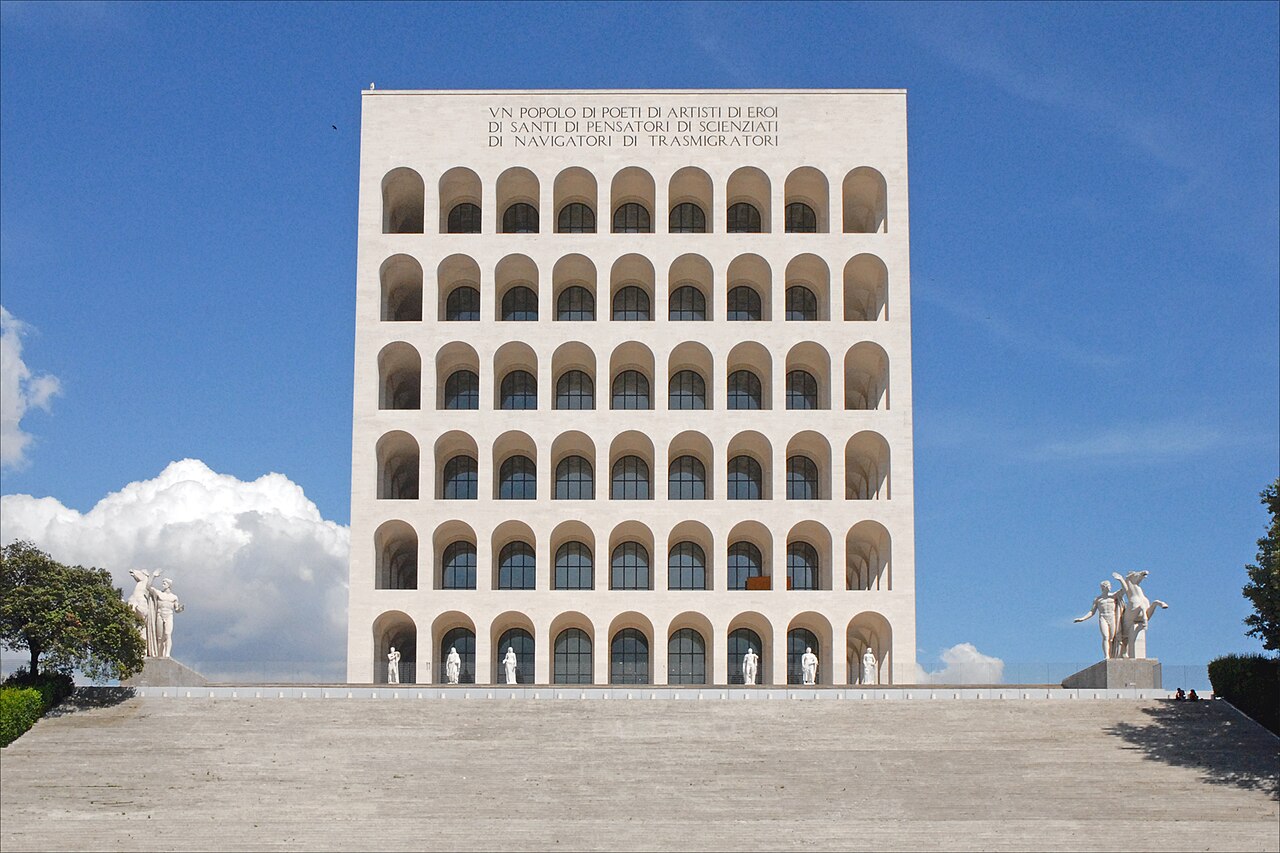
The Palazzo della Civiltà Italiana, also known locally as Palazzo della Civiltà del Lavoro, stands as an iconic monument of Rome's EUR district. Designed by architects Giovanni Guerrini, Ernesto Bruno La Padula, and Mario Romano, this squared colosseum exemplifies Fascist-era monumental architecture. Its distinctive travertine facade features fifty-four arches arranged in four tiers. Originally constructed for the cancelled 1942 World's Fair, it has become a powerful symbol of twentieth-century Italian design and urban planning, representing the regime's ambition to project modernity and imperial continuity through classical architectural vocabulary. Public access depends upon current programming and commercial occupancy. No standard daily opening is guaranteed. Visitors must verify current status before travelling.
The interior spaces have historically served various functions rather than maintaining permanent public exhibition content. Following extensive restoration, the building has accommodated cultural exhibitions and fashion house headquarters, notably Fendi's former flagship presence. The vast central hall and surrounding arcaded galleries provide dramatic spatial experiences. Visitors should note that interior access depends entirely upon current commercial or cultural programming. No permanent museum collection or standard visitor route exists. The architectural experience itself constitutes the primary interior attraction, with the interplay of light through arches creating memorable atmospheric conditions throughout the day.
Exterior appreciation requires approximately fifteen to thirty minutes for circumambulation and photography. Interior visits, when available through exhibitions or special events, typically demand forty-five to ninety minutes depending upon programming scope. The building's imposing scale rewards unhurried observation from multiple vantage points across the surrounding piazza. Visitors combining this with broader EUR district exploration should allocate half a day minimum. The monument functions best as a contemplative architectural destination rather than a rapid checklist attraction, with its geometric purity revealing itself gradually through patient observation from varying distances and angles.
The monument presents distinct atmospheric qualities across seasons and times of day. Morning light illuminates the eastern facade dramatically, while late afternoon creates golden tones against travertine surfaces. Summer midday sun produces harsh shadows within arcades. Winter visits offer clearer atmospheric conditions for distant photography. Rain transforms the surrounding piazza into reflective foreground. Special events occasionally restrict normal access. The building's exterior remains visually appreciable at all hours from public spaces, providing reliable alternative when interior access proves unavailable.
Access arrangements vary fundamentally according to current usage. Commercial tenant occupancy may preclude general public admission entirely. Special architectural tours occasionally operate through cultural institutions or professional organisations. Visitors should anticipate potential access limitations and verify current status through official Rome tourism channels or direct enquiry. Free exterior viewing from the public piazza remains permanently available regardless of interior accessibility conditions, providing guaranteed baseline experience.
The Palazzo della Civiltà Italiana occupies the EUR district, approximately four kilometres south of Rome's historic centre. Metro line B serves EUR Palasport and EUR Magliana stations, requiring subsequent walking through the planned district. Several bus routes connect to EUR from central locations. Private vehicle access encounters restricted traffic zones and parking limitations characteristic of Rome. The building's prominent position within EUR's orthogonal plan makes it navigable once within the district. Cycling presents viable option via Appian Way regional park connections. Visitors should allow additional transit time compared to central Rome attractions, particularly during weekday business hours when district traffic intensifies.
Exterior surfaces show weathering consistent with age and pollution exposure; visitors should avoid assumptions about structural maintenance standards. The vast open piazza offers minimal shelter from sun or rain; appropriate protection proves essential. EUR district planning creates wind tunnel effects around the monument. Security presence varies; visitors must respect any access restrictions without dispute. Surrounding area empties substantially evenings and weekends, affecting services and personal security perceptions. No permanent visitor facilities exist at the monument itself. Photography restrictions may apply during commercial events or filming activities. The building's cultural significance generates occasional political demonstrations or unauthorised gatherings requiring situational awareness.
The monument constitutes one of Rome's most photographically rewarding subjects, with symmetrical composition opportunities from all cardinal directions. Wide-angle lenses capture facade grandeur; telephoto lenses compress arch repetition patterns. Optimal exterior positions lie across the surrounding piazza for complete elevation visibility. Interior arcades create compelling frame-within-frame compositions when accessible. Drone operation faces strict Italian regulatory requirements and urban proximity restrictions. Commercial photography requires permit verification. Golden hour produces exceptional travertine warmth; overcast conditions reduce contrast for detailed architectural documentation. Night illumination, when operational, transforms the monument into luminous landmark. Visitors should respect any temporary restrictions during fashion or cultural events.
Is the Palazzo della Civiltà Italiana open to the public daily for Palazzo della Civiltà Italiana in Rome?
Public access depends upon current programming and commercial occupancy. No standard daily opening is guaranteed. Visitors must verify current status before travelling.
Can I enter the building without a ticket for Palazzo della Civiltà Italiana in Rome?
Interior access generally requires specific event participation or exhibition admission. Free exterior viewing from public piazza spaces remains permanently available.
How does this building relate to the Colosseum for Palazzo della Civiltà Italiana in Rome?
The design deliberately references the ancient amphitheatre's arcaded form through modernist reinterpretation, creating explicit architectural dialogue between classical and Fascist-era Rome.
What public transport reaches the monument most efficiently for Palazzo della Civiltà Italiana in Rome?
Metro line B to EUR stations provides most direct connection, followed by walking through the planned district. Bus alternatives exist from central Rome.
Are guided tours available for Palazzo della Civiltà Italiana in Rome?
Occasional architectural tours may operate through cultural institutions; advance verification essential.
Why are there two names for this building for Palazzo della Civiltà Italiana in Rome?
Palazzo della Civiltà Italiana represents official designation, while Palazzo della Civiltà del Lavoro reflects alternative nomenclature emphasising labour ideology within Fascist propaganda.

_(5904657870).jpg)