4 min walk
Tokyo Metropolitan Gymnasium
- Notable
- Activity
Language · 11 published
Activity · Tokyo
国立競技場
Reviewed by Elena Voss · Roavina Travel Editor
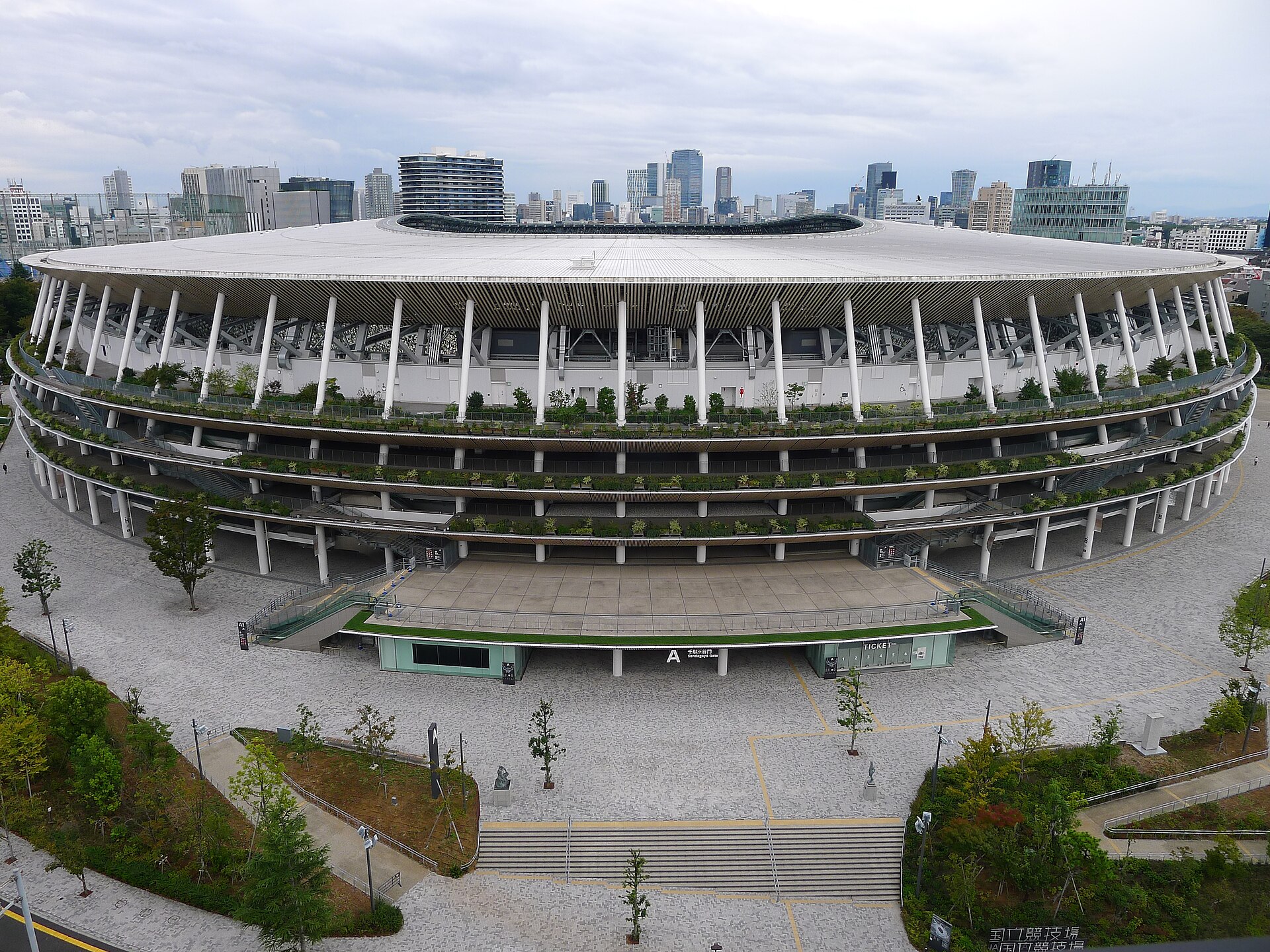
It opened in 2019. It was designed by Kengo Kuma.
National Stadium, or Kokuritsu Kyōgijō, is Tokyo’s purpose-built national venue for athletics and football. The present stadium was developed for the 2020 Olympic and Paralympic Games on a site associated with Japan’s sporting history, close to the Meiji Jingu Gaien district. Its broad timber-lined roof, layered terraces and generous exterior scale make it an architectural landmark as well as a competition venue. The building combines a working arena with a symbolic setting in the capital, continuing Tokyo’s relationship with international sport and large civic gatherings. Its importance is clearest when viewed as both an active arena and a national architectural statement.
Checked 2026-09-02 · Source
The central focus is a full athletics track surrounding a football pitch, with spectator seating rising around the field. From outside, the stadium reads as a layered bowl rather than a sealed box: roof lines, planted edges and repeated structural rhythms are visible around the perimeter. The interior is organised for large sporting crowds, competitors and event operations, so the experience changes between a quiet exterior visit and a match or athletics session. Entry beyond public approaches depends on the programme taking place and its access arrangements. The surrounding sports precinct adds context, with the stadium forming part of a larger civic landscape.
Checked 2026-09-02 · Source
Allow about 60 to 90 minutes for an exterior-focused visit. That gives enough time to walk around the visible perimeter, study the roof and timber details, pause for photographs and understand the stadium’s relationship with the surrounding sports precinct. An event visit requires a longer commitment for the journey from the station, crowd movement, entry procedures and the scheduled programme. Without confirmed general interior access, plan the shorter visit around the outside rather than expecting a museum-style tour or exhibition. A walk through the adjacent Meiji Jingu Gaien area can extend the stop without assuming access to the arena.
Checked 2026-09-02 · Source
The clearest reason to visit is a scheduled athletics or football event, when the stadium’s seating, scale and atmosphere can be experienced as intended. For a quieter architectural stop, choose a daytime period and walk the surrounding Meiji Jingu Gaien area, while recognising that access inside the venue is not established for ordinary sightseeing. Spring and autumn are especially comfortable for walking in Tokyo; summer can feel hot and humid, and event-day crowds may make the precinct much busier than expected. A non-event visit is therefore best treated as an exterior walk around a working arena.
Checked 2026-09-02 · Source
National Stadium is event-led rather than a museum with a dependable walk-up ticket. If you are attending a match, athletics meeting or other programmed gathering, admission conditions belong to that event’s organiser, ticket category and seating allocation. For a casual visit, use the publicly accessible surroundings and regard entry into controlled areas as dependent on the specific programme. Purchase event admission only through the organiser’s authorised sales channel, and allow time for the venue’s approach and entry procedures on a busy day.
Checked 2026-09-02 · Source
The closest named rail options are Kokuritsu-Kyōgijō Station on the Toei Ōedo Line and Gaienmae Station on the Tokyo Metro Ginza Line. Sendagaya and Shinanomachi stations on the JR Chūō-Sōbu Line provide additional approaches. Each route involves walking through the surrounding district rather than arriving directly inside the stadium. The location is convenient to the wider Shinjuku and Shibuya area, but station exits and pedestrian routes can feel different on event days, when crowds spread across the precinct. Leave extra walking time for a busy programme. The approach passes through Tokyo’s urban sports district before the stadium comes into view.
Checked 2026-09-02 · Source
Event days bring the practical challenges of a major Tokyo venue: crowded approaches, slower movement around station exits and controlled entry procedures. Security checks and restrictions on carried items can apply according to the organiser’s rules. The open surroundings also mean exposure to sun, heat or rain while walking between stations and entrances. If you do not hold an event ticket, keep expectations focused on the exterior and public approaches, because interior access is not established as a regular sightseeing service. Crowd conditions may affect nearby dining and transit, so build flexibility into a busy Tokyo itinerary.
Checked 2026-09-02 · Source
The exterior offers the clearest photographic subject: use the surrounding public approaches to frame the stadium’s long roofline, layered terraces and warm structural detailing. A wider view can place the building within the Meiji Jingu Gaien landscape, while closer angles reveal how the roof and façade repeat around the bowl. Photography inside during a ticketed event remains subject to the organiser’s rules, and visitors should follow posted restrictions around controlled operational areas. Changing light can alter the roof’s appearance, especially when the structure is viewed from different sides. A slow circuit shows the relationship between the low terraces, roof edge and surrounding greenery.
Checked 2026-09-02 · Source
Without admission for a programmed event, plan around the exterior and public approaches rather than assuming access to the seating bowl or arena.
National Stadium is a national athletics and football venue. It also serves as a setting for large programmed gatherings and ceremonial events.
Do not plan the visit around an assumed interior tour or exhibition. The dependable experience described here is the stadium exterior and its surrounding sports precinct.
The supplied details do not establish step-free routes, entrances or visitor facilities. Treat mobility arrangements as programme-specific rather than assuming that every public approach provides the same access.
On-site merchandise retail is not established as an everyday facility. Event-specific sales should not be treated as guaranteed outside the relevant programme.
The facility is suitable for large programmed gatherings and ceremonial events as well as athletics and football. Specific non-sport programming depends on the organiser and event calendar.
Loading the interactive map…
The interactive map could not be loaded.
Last updated:
Source: OpenStreetMap contributors, Wikidata ·